Bread in the life of Armenians
Bread has been a faithful companion of Armenians for centuries. Bread was baked in the Armenian Highlands as early as the 3rd and 2nd centuries BC. Excavations have uncovered vast reserves of wheat and barley dating back to the 4th and 3rd millennia. Archaeologists claim that people in the Armenian Highlands have been farming and domesticating durum wheat since ancient times. This suggests that Armenians initially cultivated these grains to make flour, and later to bake bread or Armenian lavash. Armenians stored their grain in various barns, warehouses, jars, and underground pits specifically designed for grain storage.
After harvesting the grain, villagers were in no hurry to deliver it to the mill. Previously, the first harvest was always taken to church and blessed. Only then could a villager gather their harvest and take it to the mill, grind the grain, and then bake bread. However, the harvest wasn’t simply gathered into a bundle for blessing. Before being brought for blessing, khachburs (traditional shawls) were made. The ears of grain were shaped like a cross, a symbol of eternity or the tree of life. The tree of life itself is a symbol of fertility, the beginning of life, and longevity.
To understand the importance of bread in Armenian life, one can simply pay attention to how Armenians refer to a meal: “There is bread.” And this, of course, is where various proverbs originate: “a man with bread” (hospitable), “let there always be bread in your house,” “if you want to know a person, you must break bread with him”… Armenians greeted each other with bread and salt, sharing bread together.
The importance of bread is even evident in Armenian epic poetry, when David repeats “Bread, wine, almighty God!” and thus gains strength before battle.
Armenians have created many types of bread: lavash, matnakash, baharj, unleavened bread, and so on.
Armenian Lavash
Lavash is not only a bread, but also a cultural element with religious and cult significance in Armenian life. First, let’s understand the origin of the name “lavash.” Lavash is an Armenian word derived from the dough-making process. After the dough is rolled out, it must be stretched and opened. This is where the word “lav kashats” (well-stretched in Armenian) came from: “lav kash,” and the bread eventually acquired its name, “lavash.”
Traditionally, the bread was baked early in the morning, and the fire in the tonir was lit at dawn. The baking process was accompanied by morning blessings and prayers. Lavash was once baked in large quantities for holidays. This process took one or even two days. There were also special songs sung during the baking process, extolling the bread’s flavor.
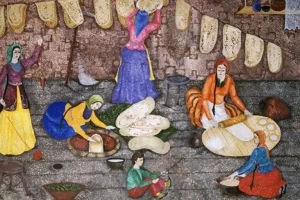
Traditionally, baking bread was a group activity, and one person couldn’t bake alone. It was an exclusively female task, and women didn’t want men entering the bakery while the bread was baking. This was considered a bad omen. Each woman had her own role: one prepared the dough, another rolled it out, and the most experienced woman slammed the lavash against the wall of the tonir. Inexperienced women mostly passed the dough balls around and learned from the more experienced women.
The baking process consisted of seven stages: grinding the wheat, sifting the flour, preparing the dough, adding salt, dividing it into balls, baking, and sorting.
The first lavash from the tonir was sent to a sick person, so that they could eat it and regain their strength.
In ancient times, lavash was a companion and protector for soldiers during wartime. Mothers baked lavash with their own hands, dried it, and placed it in soldiers’ backpacks. Thanks to its long shelf life, lavash saved soldiers from starvation.
Armenians also had a tradition of throwing lavash on the bride’s shoulder, hoping that the bride’s arrival would bring more bread to the hearth. This custom is still observed at traditional Armenian weddings. Armenians believed that lavash also protected them from the evil eye, and so lavash was thrown not only on the shoulders of newlyweds but also on newborns.
Tonir
Since pagan times, the tonir has played a vital role in Armenian life and everyday life. This underground fire symbolized sun worship. While tonirs exist in many cultures, the Armenian tonir is unique in that it is underground. The tonratun (tonir house), where the tonir was located, was considered the bakery where bread, especially lavash, was baked. This place was considered sacred. The tonir had to be kept clean at all times.
Swearing and cursing were forbidden around the tonir. The tonir was crucial, as it guaranteed the survival of the family that baked their bread there. The tonratun was also built in the most important part of the house—under the domed roof with a smoke vent. Such structures are called hazarashen.
A roof-like structure and a smoke hole facilitated the exit of smoke from the tonir. Besides bread, gata, ghapama, harisa, and other dishes were also cooked in the tonir. Tales and legends were told around the tonir. In the old days, when the bread-baking process was complete and the tonir was still warm from the fire, family members would gather and sit around it, resting their feet in the warm tonir. During this time, the eldest family member would tell the younger members tales and stories.
The tonir was considered such a sacred place that in settlements without a church, but a wedding ceremony was required, couples would do so around it. The bride and groom would circle the tonir, hand in hand. Afterward, the bride would take a handful of ashes from her father’s house and sprinkle them into the groom’s tonir. Thus, she would be bound to the groom’s hearth for the rest of her life.
The Tondrak volcanic massif in the Tsaghkunyats Mountains is the prototype of the tonir. Tondrak is a conical active volcano with a circular base. According to legend, when the god Vahagn taught the Armenian giants martial arts, they would gather around the Tondrak volcano’s fire after training.
They talked, baked bread, and ate. One day, Vahagn took the ashes from the volcanic fire and, giving them to the giants, ordered them to be delivered to the people so they could build a tonir and bake bread. He also ordered the women to always keep the fire in the tonir bright. After all this, Vahagn ascended to heaven and from there ensured that the fire in the tonir never went out. Armenians preserve the fire given to them by the god Vahagn to this day.
Magic Lavash
In 1988, one of the most popular Armenian cartoons, “Magic Lavash,” was produced. The main character was the honest and kind Naghash, who lived with his mother and grew up eating lavash made through her diligent and honest labor. One day, Naghash decides to follow his mother’s advice and find his “love of work.” But after enduring many trials, he returns to his native village, plows and sows his land, the size of a large lavash, and enjoys the fruits of his honest labor. At the end of the film, the hero recalls his mother’s words: “Remember, son, joy is in work, and happiness is in the Motherland.”
In 2014, Armenian lavash was inscribed on the UNESCO Representative List of Intangible Cultural Heritage of Humanity. Lavash was inscribed on the UNESCO list for its unique preparation and for its cultural and national significance. If this type of Armenian bread had only culinary significance, it would not have been included on the list. Armenian lavash made it onto the list due to its numerous cultural and social manifestations in Armenian life.